


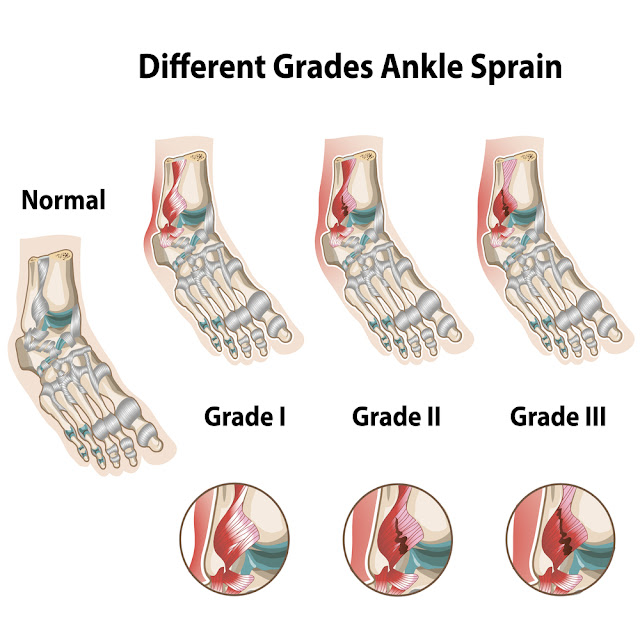
The ankle is a complex joint which allows the foot to perform a number of movements. It is connected to the foot bones by a number of ligaments at the sides and back of the joint. While these ligaments are normally very strong, extreme stretching or awkward movements can lead to injury of the ligaments.
Ankle Injuries – Some of the More Common Causes
The ankle is a rather mobile, flexible joint, however there are certain factors that increase the likelihood of a ligament injury:
- walking on uneven surfaces
- sudden twisting movement
- playing sports – especially jumping and landing awkwardly
- weak ankle muscles – not strong enough to protect the ankle
- previous ankle sprains, particularly if the treatment or rehabilitation was inadequate
When a ligament injury of the ankle does occur, it can generally be classified into one of three grades of severity, depending on the extent of ligament damage and associated symptoms.
Grade 1 Ankle Ligament Injury – Minimal Damage
This type of injury means there has been some stretching or minor tearing of the ligament(s). The symptoms include pain, swelling, possibly some ankle joint stiffness but not much functional loss. In other words, despite the pain and swelling, a person can still weight-bear and mobilise – though with some difficulty.
Treatment of mild ligament damage is by resting the foot. The less weight-bearing on the affected foot, the better. Applying an ice pack, compression bandage and elevating the foot above heart level are also very important.
Grade 2 Ankle Sprains – Moderate Ligament Injury
In this type of injury, there is a more severe tearing of the ligament. The symptoms of Grade 2 sprains are more intense – there is usually significantly more swelling and a great deal of pain. The ankle joint becomes rather stiff and range of movement is very limited. The stability of the ankle joint is also compromised.
As with Grade 1 ankle sprains, it is very important to rest the foot. Weight bearing should be avoided completely, if possible. Elevating the affected ankle above heart level, using a compression bandage and regular application of an ice pack are also essential.
Depending on the intensity of the symptoms, anti-inflammatory medication may be indicated.
Following the acute phase of the injury, rehabilitation is highly recommended in order to strengthen the ankle and restore good movement and balance.
Grade 3 Ankle Ligament Tear – Severe Ankle Injury That Requires Medical Treatment
This is the most severe of the three types of ankle ligament injuries, due to a complete rupture of the ligament. Symptoms include severe swelling and pain, gross instability of the ankle and consequently a loss of ankle function.
Treatment of this type of injury often requires surgical intervention, in order to repair the ruptured ligament. Immobilisation of the ankle in a cast is also needed, usually for around two to three weeks and the injured person could be on crutches for several weeks.
Surgery and/or immobilization of the ankle is usually followed by physiotherapy. Rehabilitation is crucial to restore the joint to its pre-injury function and to prevent any future ankle injuries.
Recovery Timeframes for Ankle Sprains Vary According to Severity of the Injury
Recovery from a Grade 1 ankle sprain is fairly quick. Depending on the extent of swelling, full recovery can be achieved within a week or two.
Grade 2 ankle sprains take four to six weeks to heal. This timeframe includes the resting of the ankle in the acute phase of the injury, as well as the subsequent rehabilitation phase. Timely treatment and adequate rehabilitation will generally reduce the recovery timeframe for Grade 2 ankle sprains.
Grade 3 sprains will take longest to heal with eight to 12 weeks being the average timeframe to full recovery. Following medical advice is very important and as mentioned before, rehabilitation is of utmost importance. Failure to treat and rehabilitate a severe ankle sprain will not only increase recovery timeframes, but will almost certainly lead to ongoing ankle problems, such as recurring injuries, pain, swelling, stiffness and poor balance.
Ankle sprains can vary in severity from Grade 1 to Grade 3, but regardless of the severity of the injury, treatment within the first 48 hours will reduce the acute symptoms and will speed up recovery.
